How to harness Esports in youth work: -Elisa Masters 2023 Viewing Party
Kare, Makkonen (2025)
Julkaisun pysyvä osoite on
https://urn.fi/URN:NBN:fi:amk-2025121134880
https://urn.fi/URN:NBN:fi:amk-2025121134880
Tiivistelmä
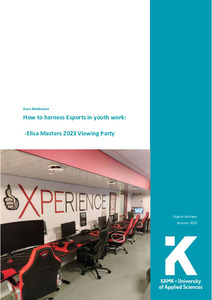
This thesis explores the potential of using esports in youth work to encourage social interaction and positive development. The study focuses on a case event called Elisa Masters Espoo 2023 Viewing Party. It was organized at Pelitila Xperience in Lahti, Finland. Applying a practice-based approach, the project was carried out by gathering observations and informal feedback from the 15 young participants.
The event combined a live Counter-Strike viewing with structured activities such as friendly competitions and team-based gameplay. These elements brought together young people who usually play alone and encouraged them to talk, collaborate, and form new connections. Observed outcomes showed clear signs of Positive Youth Development (PYD), especially in terms of confidence, social skills, teamwork, and community feeling.
In addition to these findings, the project highlights how esports-based programming can complement traditional youth work methods by offering an accessible environment in which participants feel intrinsically motivated to engage. The shared interest in Counter-Strike created a natural foundation for discussion, peer recognition, and informal mentoring, all of which strengthened the sense of belonging within the group. The presence of supportive adults further helped maintain a positive atmosphere, ensuring that competition and excitement translated into constructive social experiences rather than exclusion or conflict.
The case also demonstrates that structured esports events can provide youth workers with new opportunities to observe social dynamics and identify individuals who may benefit from additional support. Because participants were actively interacting during both gameplay and viewing segments, the event functioned as a practical setting for identifying strengths in communication, leadership, and cooperation, as well as potential areas for personal growth.
The results show that when esports events are guided by adults and intentionally structured, they can be a practical, low-cost way to strengthen social engagement in youth work.
The event combined a live Counter-Strike viewing with structured activities such as friendly competitions and team-based gameplay. These elements brought together young people who usually play alone and encouraged them to talk, collaborate, and form new connections. Observed outcomes showed clear signs of Positive Youth Development (PYD), especially in terms of confidence, social skills, teamwork, and community feeling.
In addition to these findings, the project highlights how esports-based programming can complement traditional youth work methods by offering an accessible environment in which participants feel intrinsically motivated to engage. The shared interest in Counter-Strike created a natural foundation for discussion, peer recognition, and informal mentoring, all of which strengthened the sense of belonging within the group. The presence of supportive adults further helped maintain a positive atmosphere, ensuring that competition and excitement translated into constructive social experiences rather than exclusion or conflict.
The case also demonstrates that structured esports events can provide youth workers with new opportunities to observe social dynamics and identify individuals who may benefit from additional support. Because participants were actively interacting during both gameplay and viewing segments, the event functioned as a practical setting for identifying strengths in communication, leadership, and cooperation, as well as potential areas for personal growth.
The results show that when esports events are guided by adults and intentionally structured, they can be a practical, low-cost way to strengthen social engagement in youth work.