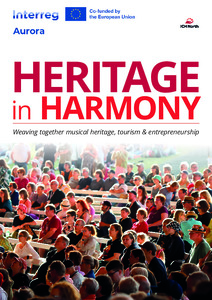
Heritage in harmony Weaving together musical heritage, tourism & entrepreneurship
Hellqvist, Anna Lisa; Granfors, Mats; Kåll-Fröjdö, Sara; Hyvönen, Kati (2025)
Centria University of Applied Sciences
2025
All rights reserved. This publication is copyrighted. You may download, display and print it for Your own personal use. Commercial use is prohibited.
Julkaisun pysyvä osoite on
https://urn.fi/URN:NBN:fi-fe202601228046
https://urn.fi/URN:NBN:fi-fe202601228046
Tiivistelmä
Welcome to this inspiration material – a collection of insights, ideas and reflections on how musical heritage can interact with tourism and entrepreneurship in meaningful and sustainable ways. The purpose of this document is to spark curiosity, offer practical examples, and encourage new ways of thinking about how living traditions can thrive in a contemporary society. At the heart of this work lies intangible cultural heritage (ICH) - the living practices, skills and expressions that the communities value, maintain, and pass forward. This definition stems from UNESCO’s Convention for the Safeguarding of the Intangible Cultural Heritage, adopted in 2003. Intangible cultural heritage, or living heritage, are traditions, knowledge or traditions that we have been taught to us and that we, in turn, feel is important enough to pass on to new generations. This could be the knowledge of how to produce a craft, social practices and festive events, oral traditions and performing arts and, among them, musical traditions.
Musical heritage as a concept might be strongly connected with folk music, but there are also a lot of other vocal and instrumental traditions that can be seen as musical heritage, as well as for example the knowledge on how to build instruments. Following UNESCO’s convention (UNESCO, 2025), any living musical tradition, or a related skill that a community or individual consider important to pass on to following generations, could be seen as musical heritage. Within this larger framework, the work presented here in this document focuses on how musical heritage can enrich tourism and strengthen local entrepreneurship, and how these sectors in turn can support the transmission of heritage. Rather than aiming for large-scale implementation, the ambition has been to experiment, listen and prototype -to explore what becomes possible when heritage is activated in contemporary contexts where people live, travel, meet and create.
Through small-scale pilots, concept development, and cross-sector dialogue, the process has generated a set of models, ideas and reflections that can inspire future initiatives. Some were tested in practice; others remain as frameworks with strong potential for development. Together, they form a growing toolbox for heritage-driven regional development. This material invites you to explore how musical heritage can play a dynamic role in shaping places, enriching visitor experiences, and strengthening communities. It is an invitation to think creatively, collaborate boldly, and continue weaving together people, traditions and places.
Musical heritage as a concept might be strongly connected with folk music, but there are also a lot of other vocal and instrumental traditions that can be seen as musical heritage, as well as for example the knowledge on how to build instruments. Following UNESCO’s convention (UNESCO, 2025), any living musical tradition, or a related skill that a community or individual consider important to pass on to following generations, could be seen as musical heritage. Within this larger framework, the work presented here in this document focuses on how musical heritage can enrich tourism and strengthen local entrepreneurship, and how these sectors in turn can support the transmission of heritage. Rather than aiming for large-scale implementation, the ambition has been to experiment, listen and prototype -to explore what becomes possible when heritage is activated in contemporary contexts where people live, travel, meet and create.
Through small-scale pilots, concept development, and cross-sector dialogue, the process has generated a set of models, ideas and reflections that can inspire future initiatives. Some were tested in practice; others remain as frameworks with strong potential for development. Together, they form a growing toolbox for heritage-driven regional development. This material invites you to explore how musical heritage can play a dynamic role in shaping places, enriching visitor experiences, and strengthening communities. It is an invitation to think creatively, collaborate boldly, and continue weaving together people, traditions and places.